From the collected and uncollected works of Rupert Giles (1954-2005)
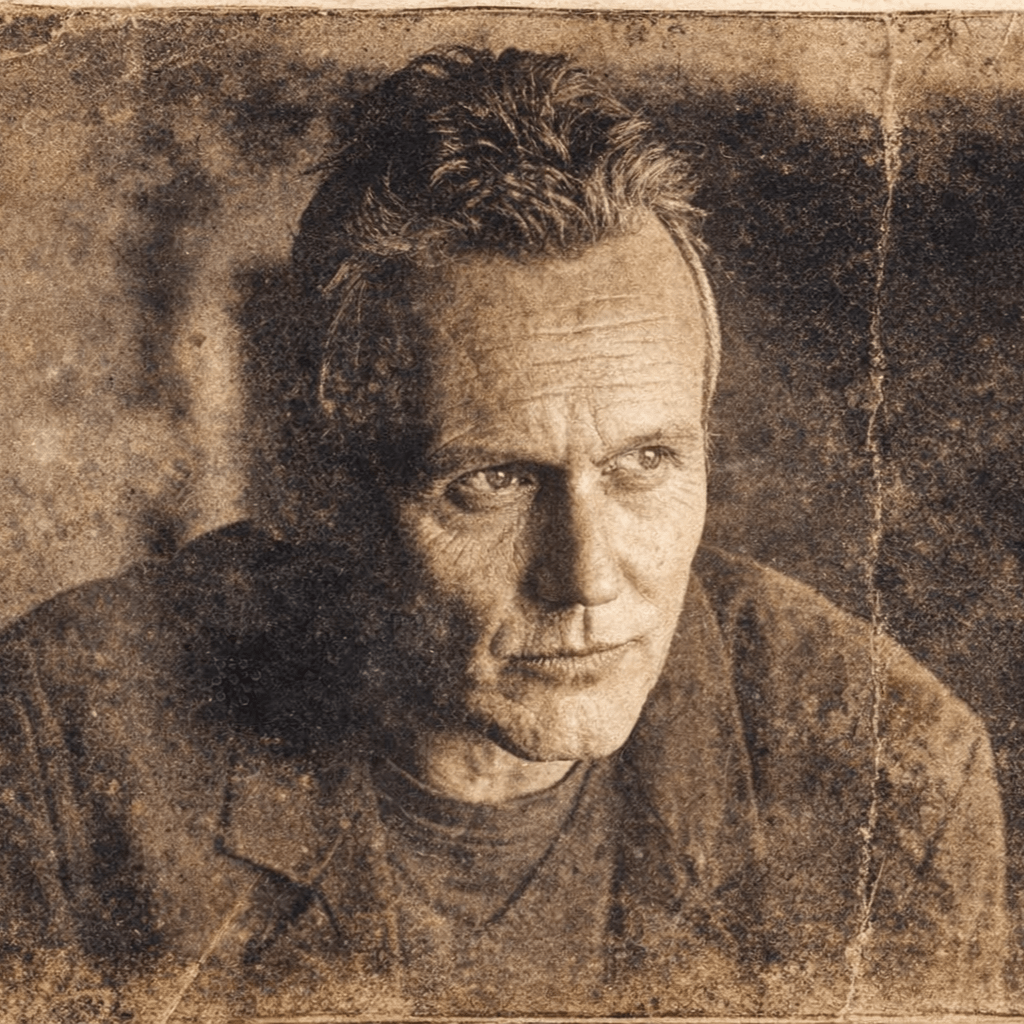
Let this record stand, though it may never be sanctioned by the Council. What follows is a chronicle of the Long Ages — the hidden history of our world, drawn from fragments, visions, and forbidden texts. Many will call it apocrypha. Some will call it heresy. Yet the patterns are too precise to ignore.
In the First Age, when the world was young and the air thick with the breath of the Old Ones, humanity cowered beneath the weight of primordial darkness. When the demons waned and the Shadow Men forged the First Slayer, a lineage was born that would echo across centuries. The Slayer stood alone, unseen by the world she saved, her battles fought in shadow and blood.
Yet the Slayer was not the only vessel chosen by forces beyond mortal comprehension. In the Age of Steam, when London’s skies were choked with smoke and ambition, a great rift tore through the firmament. A strange power descended, touching women with gifts both wondrous and terrible. They were called the Touched, and though their origins remain disputed, their emergence marked a surge of supernatural energy unseen since the dawn of the Slayer line. Governments sought to control them. Secret orders sought to erase them. But the power had chosen its vessels, and the world trembled.
In time, the rituals that kept the ancient powers at bay began to falter. Across the globe, hidden chambers performed sacrifices to appease the gods below. When the final ritual failed, the earth shook, and the old magics roared back in fury. The world teetered on the brink of annihilation, and humanity, desperate to survive, turned away from mysticism and toward the cold certainty of science.
Yet I would be remiss not to speak of the years I spent upon the Hellmouth itself — that wound in the world where the old magics never truly slept. Sunnydale was a crucible, a place where prophecy tangled with free will, and where the Slayer’s burden pressed heavier than any Council text could ever convey. It was there that I witnessed the impossible: a vampire with a soul. Angel — cursed, redeemed, and tormented — stood as proof that even the darkest beings may seek the light. And later, another: Spike, whose path from monster to champion defied every law we believed immutable.
Beyond Sunnydale, darker forces stirred. Wolfram & Hart — an institution older than most nations — waged its quiet war for dominion, weaving law, commerce, and damnation into a single tapestry. Angel’s stand against them in Los Angeles was a battle few will ever understand, fought not for victory but for the soul of the world.
And then came the Seed of Wonder — the heart of all magic, hidden beneath the ruins of Sunnydale. Its destruction ended an age. Spells faltered. Portals closed. The Slayer line itself trembled. Magic did not vanish entirely, but it became a rarer, harsher thing, no longer the great river it once was. The world changed that day, though most never knew why.
These events, though recent, belong to the Long Ages as surely as any ancient myth. For history is not measured in centuries, but in the turning of the world from one truth to the next.
– R. Giles
Addendum by Shepherd Derrial Book,
Serenity FIREFLY-Class X3-464
C/O. Southdown Abbey, Persephone**
Thus began what some scholars would later call the Age of Imprints — though I suspect the name doesn’t quite capture the sorrow of it. The Rossum men and women, inheritors of the Initiative’s old forbidden tinkering, convinced themselves they could rewrite the human mind the way a scribe rewrites a page. They believed that if they could control identity, they could tame chaos itself. But son, when people start thinking they can play shepherd to the human soul, the flock tends to scatter. Their hubris cracked the world wide open. Cities fell. Memories washed away like ink in the rain. Even the notion of who a person was became a battlefield. And when those great imprinting towers finally collapsed, all that remained was a broken world and a people left wandering, wounded and unsure of themselves.
Centuries rolled on. Magic — the old kind, the kind that once chose champions — faded into whispers. The Slayer line, once a bright thread running through history, fell silent. In the ruins of that forgotten age, vampires lingered still, though folks had taken to calling them Lurks by then. Humanity clung to survival the way a drowning man clings to driftwood. And in that desolation, destiny stirred again. A girl named Melaka Fray rose up — first Slayer in hundreds of years. Her calling was a spark in a world that barely remembered fire.
But Earth… Earth was dying. Its seas boiled, its soil turned to dust, and its people — well, they did what people always do when the ground gives way beneath them. They fled. Took to the stars in search of a future the old world could no longer offer. Out of the ashes of ancient governments rose the Alliance, carrying with them the same hunger for control that had doomed so many ages before. Their Pax experiment, meant to quiet the human heart, birthed horrors that rivalled the demons of antiquity. The Reavers became the new monsters of the dark — not born of magic, but of human folly, which is often the more dangerous kind.
I learned some of this the hard way, back when I wore the cloth at Southdown Abbey on Persephone. Folks think abbeys are quiet places, but that one sat right on the edge of the criminal underbelly — smugglers, runners, folk with more secrets than sense. Strange place for a man of God, I know. But sometimes the Shepherd goes where the sheep are most lost. And sometimes he learns things the Abbey never meant to teach.
**💬 Little Deets — E. Z. Washburne (2537)
So, like… Uncle Book wasn’t wrong about any of it. Folks out in the Black still whisper about the old powers, even if most think it’s just cortex‑drift stories. But then you hear about River Tam — girl was all kinds of cracked and brilliant — and you start wonderin’ if maybe the Slayer spark didn’t just fade out, y’know? Maybe it went quiet. Maybe it hid.
Anyway, by the time my ma was my age, nobody called ’em vampires anymore — just Lurks, skulkin’ round the lower decks of the old stations. And the Alliance kept pretendin’ everything was shiny even when half the Rim was goin’ to ruttin’ hell. Typical Core‑brain stuff.
Point is, the Long Ages ain’t just dusty scrolls or cortex files. They’re real. They’re stitched into the ’Verse like hull‑plating. Every time the night gets too long, somebody stands up. Slayer, Touched, Reader, whatever. Doesn’t matter the name. Just matters they stand.
Anyway, that’s what the old logs say. Could be truth. Could be spin. But it feels right, don’t it?
**💬 Little Deets — 修订版青少年之声(c. 2537)
Promised ma I’d translate it for the scrags to read.
所以,就像……书叔叔在这方面没有任何错误。尽管大多数人认为这只是大脑皮层漂移的故事,但黑人中的人们仍然窃窃私语着古老的力量。但当你听说了 River Tam 的故事后,你就会开始怀疑,也许杀手的火花并没有消失,你知道吗?也许一切都安静了。也许它隐藏了。
不管怎样,当我妈妈到了我这个年纪的时候,没有人再称他们为吸血鬼了——只是潜伏者,潜伏在旧车站的下层甲板上。联盟一直假装一切都闪闪发光,即使环境的一半都快要走向地狱了。典型的核心脑的东西。
重点是,漫长的时代不仅仅是布满灰尘的卷轴或皮质文件。它们是真实的。它们就像船体电镀一样被缝进了“Verse”。每当夜晚变得太长时,就会有人站起来。杀手、感动、读者等等。名字并不重要。他们的立场很重要。
无论如何,这就是旧日志所说的。可能是事实。可能是旋转。但感觉不错,不是吗?
Analysis
Across Joss Whedon’s various worlds, certain ideas return like recurring dreams: the corruption of institutions, the burden of extraordinary power, the fragility of humanity, and the stubborn resilience of found families. These echoes have led some fans to wonder whether the similarities are more than thematic. What if the stories we know — from the supernatural battles of Buffy the Vampire Slayer to the fractured futures of Dollhouse, Fray, and Firefly — are not separate universes at all, but chapters in a single, evolving timeline? What follows is not canon, nor does it claim to be. It is a creative exercise, a way of imagining how demons, magic, technology, and human ambition might shape the same world across centuries.
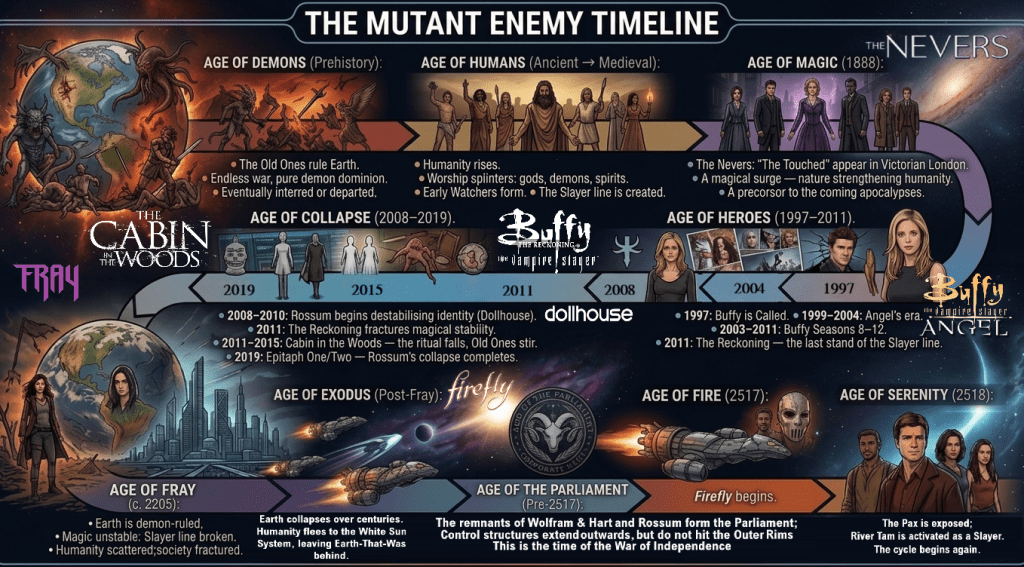
In the beginning, the world belonged to the Old Ones. These primordial demons ruled Earth long before humanity rose, and their fading influence created the conditions for human civilisation to flourish. The Shadow Men, desperate to fight back against the darkness, bound demonic essence into a young girl and created the first Slayer — a lineage that would echo across millennia. By the late twentieth century, the supernatural world still existed, but it had retreated into the shadows. Vampires, demons, and mystical forces operated unseen by the general public, while the Slayer stood as humanity’s last line of defence. This is the world of Buffy and Angel, where magic is abundant, demons are active, and the Slayer line is intact. It is also the era in which human institutions begin to take an interest in the supernatural. The Initiative, with its blend of military discipline and scientific hubris, represents the first major attempt to understand and control the supernatural through technological means.

Long before Buffy’s time, however, the supernatural world had already surged in unpredictable ways. In Victorian London, the events of The Nevers reveal a moment when a mysterious, otherworldly force sweeps across the city, granting extraordinary abilities to a group of women — and a few men. These “Touched” individuals embody a strange fusion of magic, mutation, and destiny, echoing the Slayer’s own origins. Their emergence unsettles governments, secret societies, and the social order itself. In a unified timeline, The Nevers becomes a transitional chapter: a flare‑up of supernatural energy in an age on the cusp of modernity, a reminder that magic is volatile and deeply tied to the fate of women chosen — or cursed — by forces beyond their control. It also foreshadows the later tension between empowerment and institutional control that becomes central in Dollhouse.
If Buffy and Angel show us a world where the supernatural is hidden, Cabin in the Woods reveals the machinery behind that secrecy. Governments across the globe collaborate to appease ancient gods through ritual sacrifices, maintaining a fragile truce between humanity and the primordial forces beneath the earth. In this speculative timeline, Cabin in the Woods marks the collapse of the supernatural order. When the rituals fail, the ancient powers rise, and humanity faces an extinction‑level event. This catastrophe forces governments to abandon magical containment entirely. The age of demons ends not with triumph, but with disaster, and humanity turns away from mysticism toward something colder and more controllable.

In the aftermath of this collapse, the world pivots sharply toward technology. The Initiative’s early experiments evolve into something far more ambitious — and far more dangerous. Rossum Corporation emerges as the inheritor of every government’s desire to control threats, not through magic, but through the human mind itself. Dollhouse represents the era in which identity becomes programmable, morality becomes negotiable, and technology replaces mysticism as the dominant form of power. The imprinting technology, capable of rewriting personalities, becomes the new frontier of control. When the system inevitably collapses, the world fractures under the weight of its own inventions, leading to the apocalyptic landscape glimpsed in Epitaph One and Epitaph Two. Humanity survives, but only just, and the scars of this technological catastrophe shape the centuries that follow.
Centuries later, society has rebuilt — but badly. Magic has vanished, the Slayer line has gone dormant, and humanity is spiritually hollow. This is the world of Melaka Fray, the first Slayer called in hundreds of years. Vampires, now known as Lurks, thrive in the shadows of a broken world, while technology limps along in the hands of the wealthy. Fray’s era is a dark age between Earth’s collapse and humanity’s eventual exodus. The supernatural has not disappeared entirely, but it has become a relic, a whisper of a world long forgotten.

By the twenty‑sixth century, Earth is no longer habitable. Humanity has fled to the stars, colonising new worlds under the rule of the Alliance — a government born from the same impulses that drove Rossum, the Initiative, and every corrupt institution before them. Blue Sun becomes the new face of mind‑control research, inheriting the legacy of imprinting technology. The Pax experiment on Miranda, intended to pacify a population, instead creates the Reavers — a technological echo of demonic corruption, a reminder that humanity’s attempts to control itself often lead to monstrosity. The Operatives serve as the Alliance’s morally absolute enforcers, while the ‘Verse becomes a patchwork of cultures, languages, and scars from Earth’s long decline.

Within this far‑future landscape, River Tam becomes a figure of particular interest. Her prophetic visions, combat instincts, preternatural reflexes, and emotional sensitivity all echo the traits of a Slayer. If the Alliance’s brain‑mapping technology is derived from Rossum’s imprinting systems, it is possible that River’s mind was probed deeply enough to activate a dormant Slayer potential — a spark buried in humanity’s genetic memory. In this reading, River becomes a mythic warrior in a world that has forgotten magic, a final echo of a lineage that began with the Shadow Men and stretched across centuries.
This unified timeline is not canon, nor does it need to be. Its purpose is to explore the thematic threads that run through Whedon’s work: the rise and fall of civilisations, the tension between destiny and autonomy, and the enduring power of chosen families. Whether or not Buffy, Echo, the Touched, Melaka Fray, and River Tam truly share a universe, imagining the connections between them reveals something essential. Each story, in its own way, asks what it means to be human in the face of overwhelming darkness. And sometimes, the joy of fandom lies not in definitive answers, but in the possibilities.