



“In every generation there is a Chosen One. She alone will stand against the vampires, the demons and the forces of darkness. She is the Slayer.”
Rupert Giles
Across centuries and continents, the Slayer line has moved like a hidden current beneath human history — one girl at a time, chosen to stand where no one else can. Empires have risen and fallen, faiths have clashed, revolutions have burned, and still the Calling has passed from hand to hand, shaping lives that rarely make it into the stories the world tells about itself. These tales belong to the forgotten, the unnamed, the ones who fought in silence long before the world learned the word “Slayer.”
Each era forged its Slayer differently. Some were born into war, some into faith, some into poverty or privilege, and some into futures stranger than prophecy ever imagined. Their battles were shaped by the fears of their age — inquisitors, tyrants, monsters in the dark, and monsters in plain sight. Yet beneath the armour, the paint, the gowns, the uniforms, the neon lights, they all carried the same burden: to stand alone against the darkness, even when the darkness wore a human face.
Tales of the Slayers gathers these lives into a single lineage — not a straight line, but a constellation. Each story is a spark in the long night, illuminating the girl who held the line before the next was called. Some triumphed, some fell, some were betrayed by the world they saved, and some changed that world in ways it never understood. Together, they form the true history of the Slayer: not a prophecy, but a legacy written in courage, sacrifice and the fierce, stubborn refusal to let the dark have the last word.
PROLOGUE | RIGHTEOUS | THE INNOCENT | PRESUMPTION
THE GLITTERING WORLD | SONNENBLUME | NIKKI GOES DOWN!
TALES
PROLOGUE
Written by JOSS WHEDON
Artwork by LEINIL FRANCIS YU
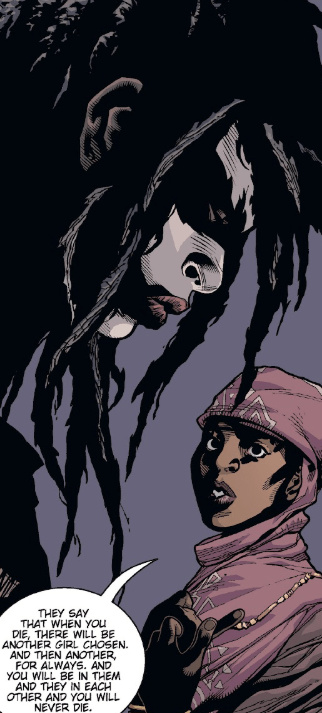
Sineya, the First Slayer, moved like a shadow across the edge of an African village, her body painted in earth and ash, her silence older than language. She brought down a vampire with brutal efficiency, dust rising around her like a whispered prayer.
When the danger passed, a young villager approached her with trembling reverence, offering food and a message from the elders: gratitude for her protection, and a plea for her to leave. They feared her — the demon spark in her blood, the mark the Shadowmen had forced upon her. The girl explained that this was why there would only ever be one Slayer at a time, each girl destined to inherit Sineya’s burden when she fell. Sineya listened without protest, her expression unreadable beneath the paint.
Then she turned away, carrying with her a strange mixture of confusion, pity and a quiet, unexpected comfort — the knowledge that she would not be the last.
RIGHTEOUS
Written by JOSS WHEDON
Artwork by TIM SALE
In a medieval English village, a young maiden received the calling she had prayed never to hear. Believing that God would not curse her with such a burden, she rejected the mantle of the Slayer, clinging to faith and the fragile hope of an ordinary life. But as the signs mounted and the darkness drew nearer, she came to see her destiny not as punishment but as sacrifice — a suffering she likened to Christ’s own. She trained relentlessly, studied scripture and combat in equal measure, and turned away every suitor, devoting herself wholly to God and to the battle she knew was coming.
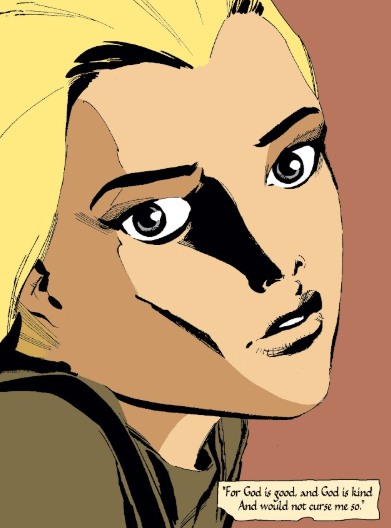
Word spread of Saint Just, a powerful vampire whose passage left only ashes and widows behind. As he moved from town to town, the maiden prepared herself, sharpening her weapons and her resolve. When he finally reached her village, he scaled its walls with monstrous grace and tore them open for his followers. Panic swept through the streets. The men fled to the church, refusing the call to arms, leaving their salvation in the hands of the girl they had barely accepted.
The Slayer met Saint Just in the heart of the chaos, steel against fang, faith against hunger. Their battle was fierce and brief, ending with her blade severing his head and sending his pack scattering into the night. The village was saved — but victory brought no celebration. Instead, the priest accused her of witchcraft, claiming no woman could wield such power without consorting with the Devil. Fear turned to zealotry, and the people she had protected dragged her from her bed and condemned her.
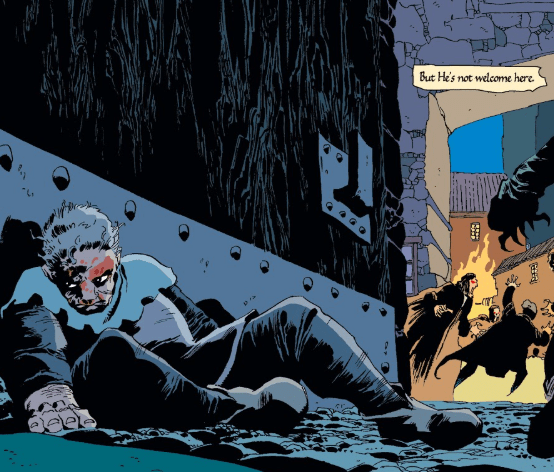
She was burned at the stake before dawn, flames rising against the sky as her Watcher watched helplessly, powerless to intervene. Her death was swift, her sacrifice unacknowledged, her courage twisted into sin by those too frightened to understand her. When the fire died, the villagers rejoiced, believing they had purged evil from their midst.
But her Watcher, broken by grief and fury, opened the gates to the remnants of Saint Just’s pack. The vampires swept through the village, slaughtering the townsfolk and tearing down the sanctuary they had hidden in. The Watcher fell among them, choosing vengeance over survival. By sunrise, nothing remained but ruins — a village destroyed not by monsters, but by its refusal to honour the girl who had saved it.
THE INNOCENT
Written by AMBER BENSON
Artwork by TED NAIFEH
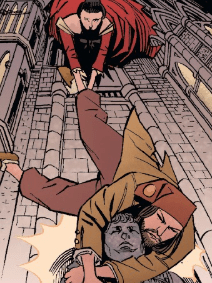
In the fevered streets of 1789 Paris, Claudine fought as both Slayer and sans‑culotte, a blade in one hand and revolution in the other. With her Watcher and lover, Jean, she hunted a vampire across the heights of Notre Dame, their silhouettes framed against the burning sky. The creature dragged Jean over the edge, and Claudine caught him by the wrist, saving his life at the cost of her own footing. She fell, striking the ground hard, while the vampire was impaled on the iron fence below. Broken but not beaten, he tore himself free — only for Claudine to rise, bloodied and furious, and drive her stake through his heart.
Jean sent her out again before dawn, speaking of another monster: an aristocratic tyrant who fed on the poor and hid in an apartment on the Rue Saint‑Denis. Claudine scaled the walls like a shadow and slipped into the library where her target waited. The man fled, and she staked him cleanly — only to realise, too late, that he was human. His dying plea begged her to spare his children. Claudine turned and found three terrified daughters and a woman staring at her. She stumbled back, tripping over the corpse, and fell into a pool of the man’s blood, her hands and face stained with the truth of what she had done.
Shaken, she found Jean in a tavern, drinking with comrades who toasted the Revolution’s rising tide. Dragging him outside, she demanded answers. Jean confessed without shame: he had known the man was no vampire. Aristocrats deserved death, he said, and Claudine — his “Angel of Death” — would be the blade that struck down those who escaped Madame Guillotine. He spoke of purging the old world, of cleansing France with her hands. Claudine spat in his face and walked away, severing the bond between Slayer and Watcher, lover and beloved.
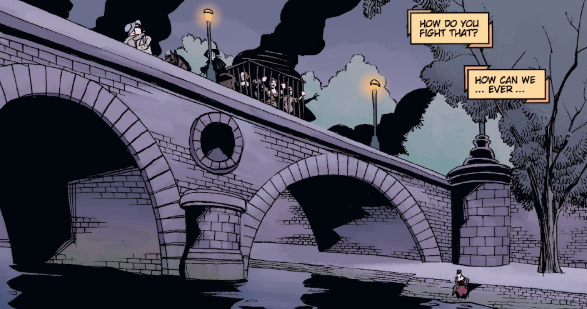
She wandered to a bridge where a couple embraced in the shadows and a caged carriage rattled past, carrying prisoners toward their fate. Blood dried on her skin, stiffening like a second mask. Claudine stood alone, watching Paris breathe in revolution and exhale violence. She had been created to fight monsters, yet tonight she had killed a man. She had been taught to trust her Watcher, yet he had used her as a weapon for his own cause. In the flickering torchlight, she understood that evil did not wear fangs or titles — it lived in choices, in zealotry, in the hands of those who believed themselves righteous.
PRESUMPTION
Written by JANE ESPENSON
Artwork by P. CRAIG RUSSELL
In 1813, at a glittering ball in Porter Hall, Somersetshire, Catherine moved through the candlelit crowd with the poise expected of a young lady of standing, though her sister fretted that she had been “thoughtful and low” of late. Introduced to Edward Weston, she accepted his hand for a dance, all the while reflecting on how the clever, charming women around her remained blissfully unaware of the monsters that stalked their world. When Edward’s hand met hers, cold as marble, Catherine recognised the truth of what he was — and of what she was meant to do.
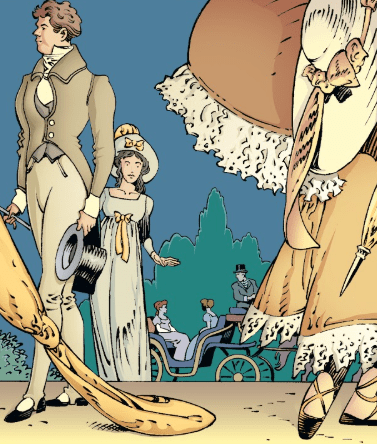
As they danced, Catherine teased him about the attention he drew from the neighbourhood’s unmarried ladies, who longed to know his tastes, his habits, even his favourite meals. Edward bristled, offended by the scrutiny, and abruptly ended the dance, drawing curious glances from the room. Catherine apologised, but the moment had soured. She told herself it was for the best; attraction to the creature she was destined to destroy was a luxury she could not afford. To her sister, she dismissed him as a man who strove to be admired yet resented being noticed — “an unpleasant mix of presumption and resentment.”
In the card room, Edward’s brother questioned why he had retreated after singling Catherine out as a “target.” Edward insisted he was merely reconsidering his approach. Soon after, he returned to Catherine with a cup in hand, asking whether she was always so direct with new acquaintances. She replied that society granted women few freedoms beyond learning what they could and saying what they dared. Seeing her frustration with the confines of her role, Edward challenged her to step onto the terrace — forbidden ground for an unmarried lady. Catherine accepted, slipping through the door into the night air, Edward close behind.
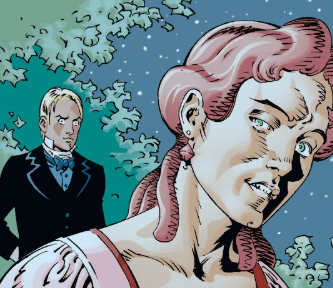
Alone at last, Catherine revealed her true face — the ridged brow and fangs of a vampire. But before she could strike, a stake pierced her heart. The Slayer stepped back from the falling body, wiping blood from her hands as she fled into the shadows. Outside the estate, her Watcher waited. “Did you get her, Miss Elizabeth?” he asked. She nodded, answering that she had — and that she was to be called Edward. The strictures of society had long ago forced Elizabeth Weston to abandon the life of a woman, adopting a man’s name and attire to move freely, hunt effectively, and survive in a world that denied her agency.
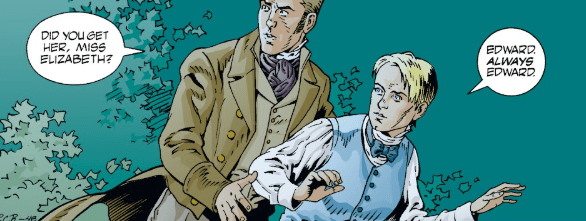
Together, Slayer and Watcher slipped away into the night as the ball continued, music drifting through the open windows. Inside, the guests danced on, unaware that death had passed among them twice that evening — once in the guise of a gentleman, and once in the guise of a lady who refused to be confined by the world she protected.
THE GLITTERING WORLD
Written by DAVID FURY
Artwork by STEVE LIEBER
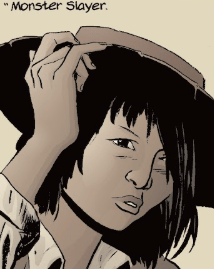
Across the wide desert, beneath a sky the colour of burning copper, Naayéé’neizgháni rode her horse with the quiet certainty of one born to slay monsters. In Navajo legend she was a figure of myth, a Monster Slayer whose name carried the weight of stories older than memory. When she came upon a caravan torn apart by vampires, she followed the trail of blood and dust to a ghost town where demons drank and sang in a ruined tavern. She stepped through the door like a storm. With bow and arrow she cut through the revelry, her shots swift and unerring, sending vampires to ash before they could rise from their seats.
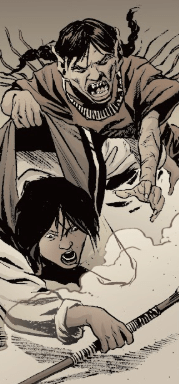
When the last creature fell silent, the bartender — trembling beneath her gaze — revealed the hiding place of the one she sought. Naayéé’neizgháni confronted Tó Bájíshchíní, a Slayer who had murdered her own Watcher. Tó spoke without remorse, calling the dead man just another white soldier like the father who had raped her mother. Rage and grief twisted her words, and the two women clashed with the ferocity of warriors shaped by different wounds. Naayéé’neizgháni struck the killing blow, but not before Tó’s blade found her flesh. The Monster Slayer fell to her knees, mortally wounded, her breath thinning beneath the desert sun.
Years later, the tale was told again — this time by a priest to a man who had purchased the land where the battle had taken place.
The man spoke of building a town there, of taming the wilderness and raising walls where the wind once carried only silence. The priest recounted the story of Naayéé’neizgháni, of the blood spilled and the justice sought, of the Slayer who died fighting both monsters and the pain left behind by men. The land listened, as it always had, holding the memory of the Monster Slayer in its dust, its stones, and its stories.
SONNENBLUME
Written by REBECCA RAND KIRSHNER
Artwork by MIRA FRIEDMANN
On 10 September 1938, fourteen‑year‑old Anni “Sonnenblume” stood among the ranks of the Hitlerjugend in Nuremberg, her small frame swallowed by uniform and ideology as Adolf Hitler’s voice thundered across the rally grounds. Afterward, her brother reminded her of her mother’s errand, and Anni dutifully went to the Jewish bakery run by the Green family. Mrs. Green returned her mother’s rolling pin with a warm smile. On the walk home, Anni spotted a vampire slipping between the alleys and killed him with the broken rolling pin, scattering bread and flour across the cobblestones. Her mother scolded her for the ruined groceries — and for buying from Jews at all.
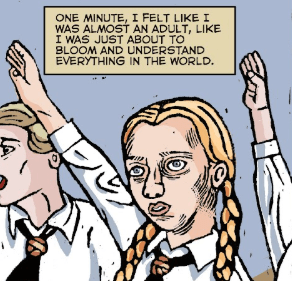
As Anni trained with her Watcher, she began to understand that evil came in many forms, not all of them supernatural. Yet at the Hitlerjugend meetings she was taught that Jewish people were the enemy, that purity and obedience were virtues, and that loyalty to the Reich mattered more than truth. The contradictions gnawed at her, but she buried them beneath duty, fear and the desperate desire to belong.
One afternoon, walking with friends, Anni passed the Green bakery again. Mrs. Green greeted her kindly, but her friends jeered, mocking her for knowing a Jew. Caught between shame and indoctrination, Anni lashed out at the woman who had shown her nothing but gentleness. The moment passed quickly, but it left a bruise on her conscience that training and propaganda could not erase.
Days later, while patrolling, Anni witnessed the violence of Kristallnacht firsthand — soldiers smashing windows, dragging families into the street, beating civilians whose only crime was their heritage. The world she had been taught to trust revealed its true face. When an officer demanded she identify the Greens, Anni felt the weight of every lesson her Watcher had tried to teach her. Instead of obeying, she struck him, choosing defiance over complicity.
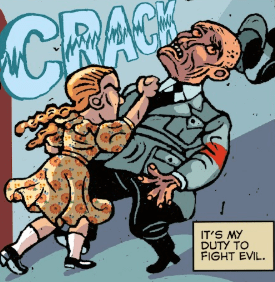
Blood pounding in her ears, Anni fled into the chaos, determined to find the Green family and protect them. She understood then that being a Slayer meant more than killing monsters — it meant recognising them, even when they wore uniforms, even when they stood in the light. She refused to be like everyone else, refused to let hatred dictate her choices. In the burning streets of Germany, Anni “Sonnenblume” chose her own path, stepping out of the shadow of indoctrination and into the far more dangerous light of conscience.
NIKKI GOES DOWN!
Written by DOUGLAS PETRIE
Artwork by GENE COLAN
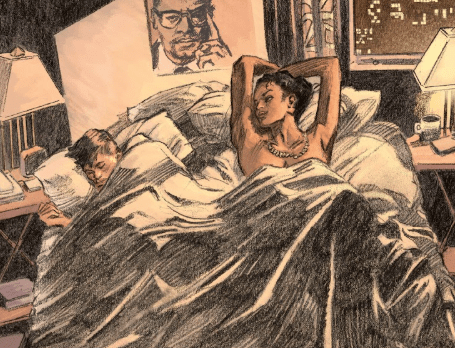
In 1970s New York, Nikki Wood woke in the warm tangle of sheets and the steady breathing of her lover, Li, an NYPD officer who knew nothing of the Slayer sleeping beside him. When he slipped out into the night, Nikki followed, shadowing him across the city’s sleepless streets until she found him on a stake‑out. Li believed he was tracking a drug smuggler named Le Banc. Instead, Le Banc was trafficking vampires. When the creatures attacked, Nikki fought with everything she had, but Li was killed before she could reach him. Other officers found her cradling his body, blood on her hands, grief in her eyes — and suspicion in theirs. She ran.
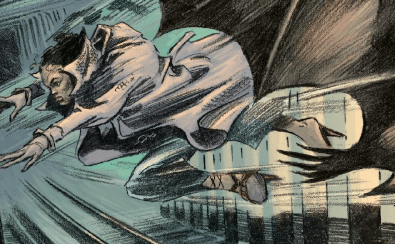
Driven by fury and loss, Nikki beat answers out of demons until she learned that Le Banc planned to unveil his “cargo” at a high‑society party. She crashed the event in a blaze of righteous anger, only to discover that the cargo was an enormous bat‑like creature, a monster that burst through a window and took to the sky. Terrified of heights but refusing to let it escape, Nikki leapt after it, clinging to its back as it soared over the city. Using her pearl necklace as a makeshift bridle, she forced the beast into a dive, steering it toward a subway station. At the last moment she leapt free, sending the creature crashing into an oncoming train.
Months later, Le Banc lounged on a yacht in the Bahamas, drinking in the sun and believing himself safe. Another nest of the monstrous bats had been found there, and he had come to profit from them. From the shore, Nikki watched him through the scope of a crossbow, her breath steady, her resolve unshaken. She squeezed the trigger. The bolt flew true.
Nikki Wood walked away from the water’s edge without looking back, the city’s grief still heavy on her shoulders — but her justice delivered.
TALES
Written by JOSS WHEDON
Artwork by KARL MOLINE
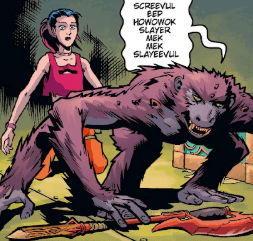
In the fractured sprawl of Haddyn, Melaka Fray leapt across rooftops on her way to a grab for Gunther, only to be ambushed by vampires older than the city’s bones. They moved with the precision of warriors who had fought Slayers for centuries — but Mel had never inherited the Slayer’s prophetic instincts, no whispers of past battles to guide her. She fought on instinct alone, raw and furious, and still managed to dust them, breathless and bruised. When she cracked open the box she was meant to retrieve, a four‑armed spider‑monkey exploded out of it, snatched her Scythe and vanished into the chaos of the streets.
Mel tore after it through the neon‑lit crush of Haddyn, dodging hover‑cars, leaping over market stalls and cursing Gunther’s name with every step. The creature led her into an abandoned apartment block, a forgotten relic of a world long past. Inside, she found a room tiled with the image of a red Scythe — her Scythe — and shelves lined with ancient Watchers’ Diaries, their pages yellowed but intact. The spider‑monkey curled up and fell asleep as if its task were complete.
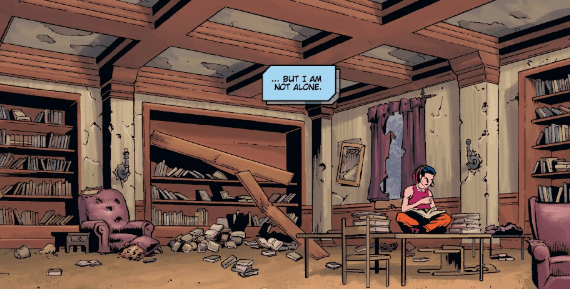
Melaka Fray stood in the quiet, surrounded by the ghosts of Slayers she had never known, their stories inked in languages older than her city. She touched the spines of the books, opened one, and read. For the first time in her life, she felt the weight of a lineage she had never been allowed to inherit — not visions, not dreams, but history. She wasn’t alone anymore. She never had been.


 The Watcher's Guide