



Written by The Curator
Based on an idea by Juliet Landau & Christos Gage
Artwork and Covers by Steve Morris
“You’re cracked the way I dreamed. Show me the story I forgot.”
Drusilla
She crossed continents like myth.
Istanbul met me with heat, hymns, and history too old to stand still. I came with tape residue on my palms and static behind my eyes – still chasing her, though I no longer believed in catching.
Drusilla wasn’t a story anymore.
She was scripture.

I took a room above a forgotten museum in Karaköy, the kind that smells of leather bindings and rust. My window looked down on the Bosphorus, where old men fished in silence and cats fought for scraps in the morning sun. I didn’t sleep. Instead, I listened – to ferry engines and midnight prayer calls. To the wind. To the stories.
“She wore a cathedral once,” said a spice vendor in Eminönü. “It shimmered when she moved. Like the glass remembered her sins.”
Another man told me she’d been seen whispering to pigeons on a rooftop above Sultanahmet.
“They fell silent,” he said. “Birds don’t lie.”
I followed her through fragments.
A bathhouse with red-silk walls. A gallery that used to be a bank. A crypt turned into a poet’s café. Each place bore her signature in clues – not graffiti, but disruptions.
A cracked icon here. A bleeding canvas there. In one, the shadow of her shoe on a prayer mat. In another, her voice etched into the audio system: a three-second laugh that played randomly between Turkish folk songs.
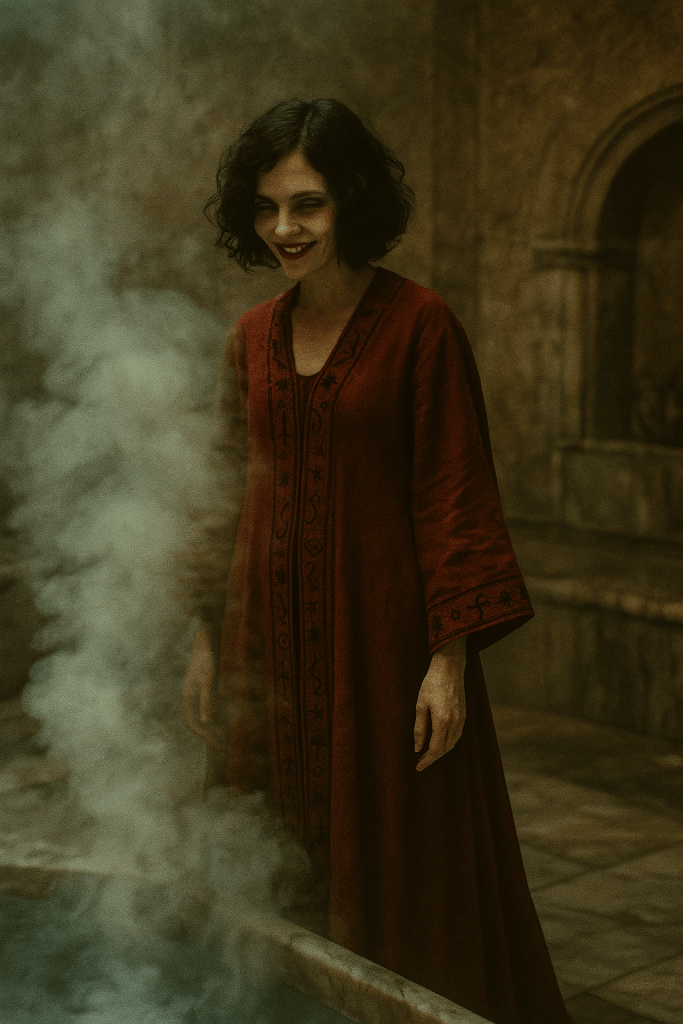
At the bathhouse, a woman recited poetry while steam swirled like ghosts.
Drusilla entered through the side corridor, robe stitched with verses. Not ink – thread. Words knotted in crimson, swaying with each movement like curses too beautiful to forget. The room fell silent.
She sang to the steam.
And it answered – curling tighter, pulsing once, then clearing around her like reverence.
One witness claimed she etched symbols into the tile with her fingernails. Spirals, teeth, flames.
“They whispered to me,” he said. “Through my eyes.”
Later, he was institutionalised for self-blinding.
My journal became a shrine.
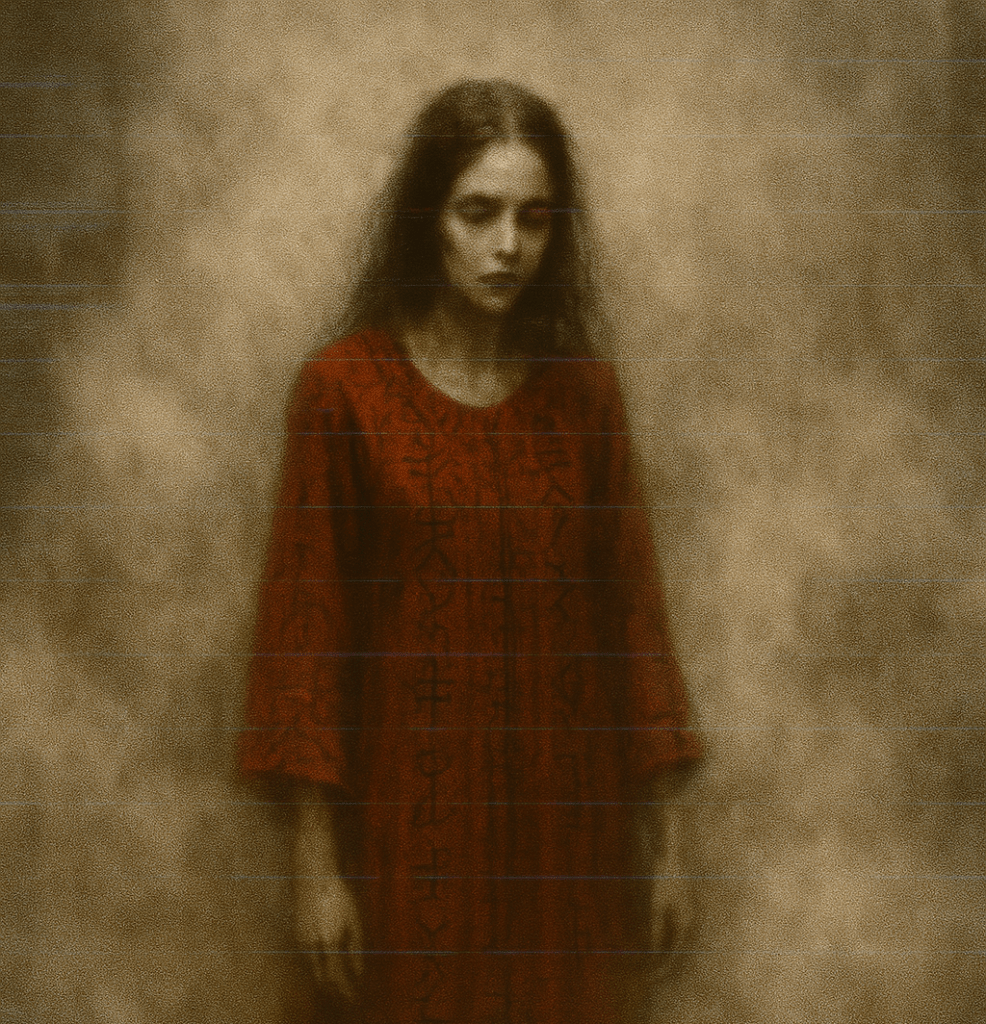
Sketches of her robe. Transcripts of overheard prayers. A page entirely filled with the word glass – over and over in my handwriting, as though I’d lost a night and only memory remained.
I began drawing cathedrals I hadn’t visited.
Painting spirals with tea and blood.
Speaking to shadows beneath my floorboards.
She was shifting.
Not just mad – but mystic.
Her madness had form now. Structure. Devotion.
At Hagia Sophia, I found her under the outer dome – alone except for two birds and a guard who couldn’t seem to see her. She pressed her palm to a shattered mosaic of Mary and whispered:
“You’re cracked the way I dreamed. Show me the story I forgot.”
Then she looked at me.
Eyes like prophecy. A smile like fate.
Not welcome. Not recognition.
Just inevitability.
I followed as far as I dared.
Through underground passageways beneath Sultanahmet.
Past stone too old for names and moisture that smelled of relics.
She slipped into a basement tunnel and vanished.
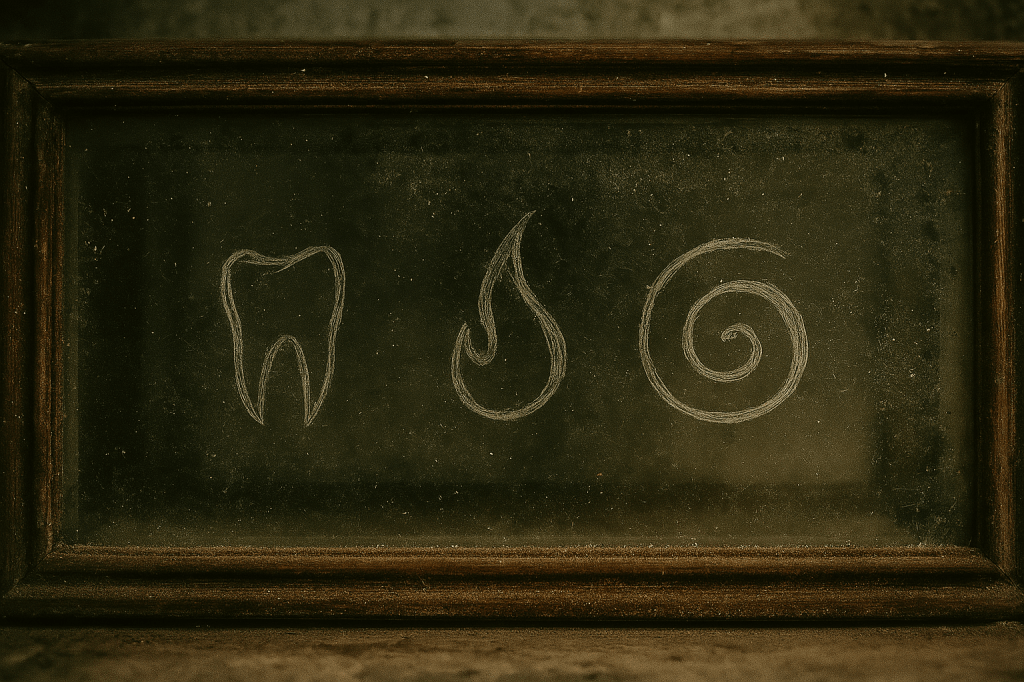
There, I found her writing.
Three symbols carved into the glass frame of an abandoned display case: a tooth.
A flame. A spiral.
The prophet speaks in shapes.
And never twice.
In Istanbul, she stopped performing.
She started preaching.
I left with nothing I could prove. Just notebook pages that sang when I opened them, and a sense that history was changing.
That maybe she was history.
And I was still late.


 The Watcher's Guide